Metchosin won $7M for its fire hall. Its own estimate puts the project near $21.4M
The grant is substantial. The district's early estimate still leaves a gap of roughly $14.4 million, before the design, approvals and financing are settled.
By The Westshore · Sep 16, 2026 · 2 min readCorrection?
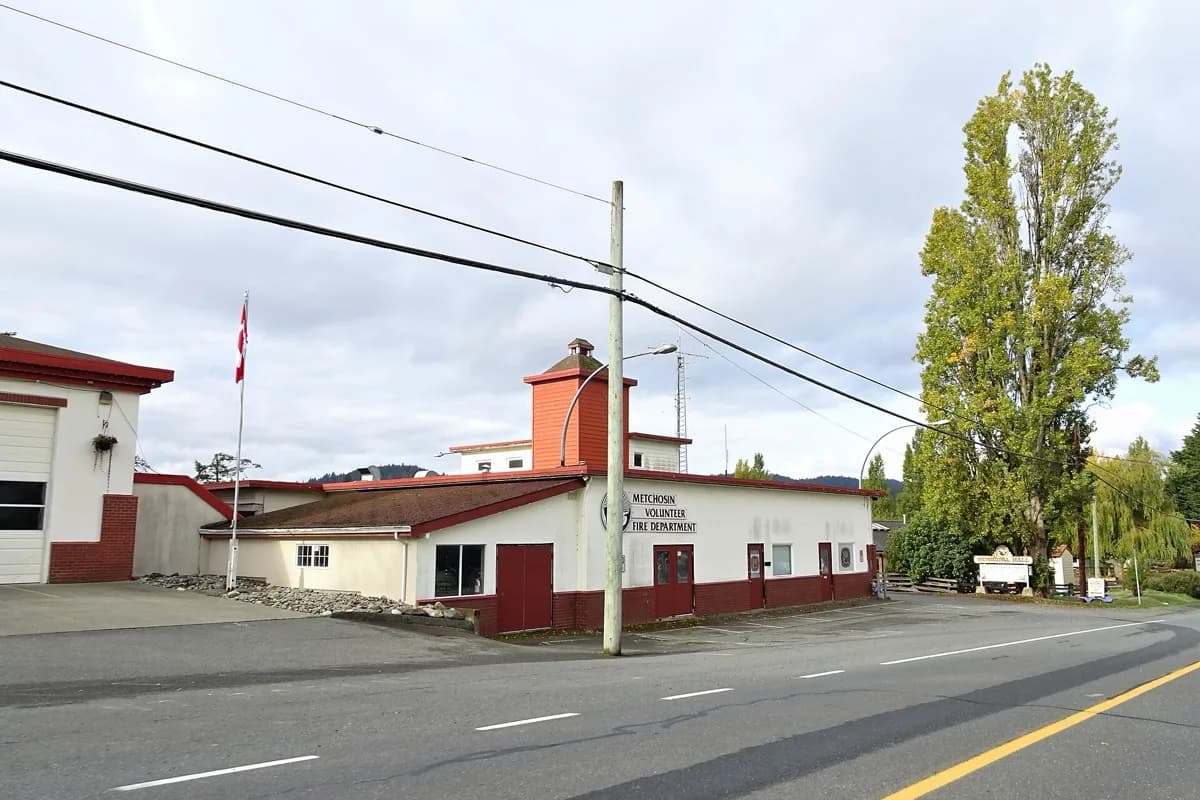
Metchosin's existing fire station, photographed in 2024. Photo. · Image source · Licence
Metchosin has secured $7 million toward replacing its fire hall. That is the good-news number in the district's July announcement.
The harder number is in Metchosin's own project material: $21,358,350.
That Class D estimate combines $16,429,500 for the fire hall with a $4,928,850 contingency. At this early stage, the district says the estimate could land 20 per cent lower or 30 per cent higher. The $7 million grant therefore covers about one-third of the working estimate, not the whole building.
Simple subtraction leaves roughly $14.36 million still to be accounted for. That is not a final taxpayer bill. The design can change, costs can move, and Metchosin could secure other grants. It is the clearest available picture of the financing question residents will eventually have to answer.
Why the existing hall is not a small repair job
The district's case for replacement is not about a tired-looking building.
Its fire-hall Q&A says the unreinforced masonry administration and sleeping area could partially or completely collapse under the seismic forces used in current building codes. It says the apparatus bay has less than half the capacity required of a modern post-disaster building, while some roof connections are at roughly 10 per cent of that standard.
The hall also lacks the ventilation and decontamination spaces expected in a current fire station. Firefighters can return from a call carrying smoke residue and other contaminants on their clothing and equipment. Keeping that material away from living and working areas is part of the building's job.
The preferred concept, called Option 1A, would build a replacement on the adjacent field while the existing hall remains in service. That sequencing matters in a community that cannot simply stop answering emergency calls while construction is underway.
The site carries another decision
The adjacent field at 4450 Happy Valley Road is in the Agricultural Land Reserve. Metchosin's project material says the preferred option would require approval for non-farm use or removal from the reserve.
Metchosin. Photo: P199 / Wikimedia Commons, CC BY-SA 4.0.
That leaves the project with three connected questions: what will be approved on the site, what the final design will cost, and how the remaining share will be financed.
The district has identified reserves, taxation, borrowing and additional grants as possible sources. It has not made a borrowing decision. The cost will be refined through design and procurement.
What the $7 million changes
The grant came through the Strategic Priorities Fund, an application-based program funded by the federal Canada Community-Building Fund in British Columbia. Metchosin was one of 54 projects sharing about $152.3 million in the first intake.
Seven million dollars gives the district real room to proceed. It does not remove the need for public decisions about scope and debt.
The next useful documents will be an updated cost estimate, a site-approval decision, a clearer design and a financing plan. Until those arrive, the honest summary is simple: Metchosin has won a large grant for a building it says it needs. The grant is about one-third of the current working estimate.